
English 
T: +86-18251114333
E: kingleo_sz@126.com
E: kingleo_sz@126.com
3rd Floor, Building 2, No. 338 Jiangzhuang Road, Guoxiang Street, Wuzhong District, Suzhou City
Views: 0 Author: Site Editor Publish Time: 2026-10-16 Origin: Site


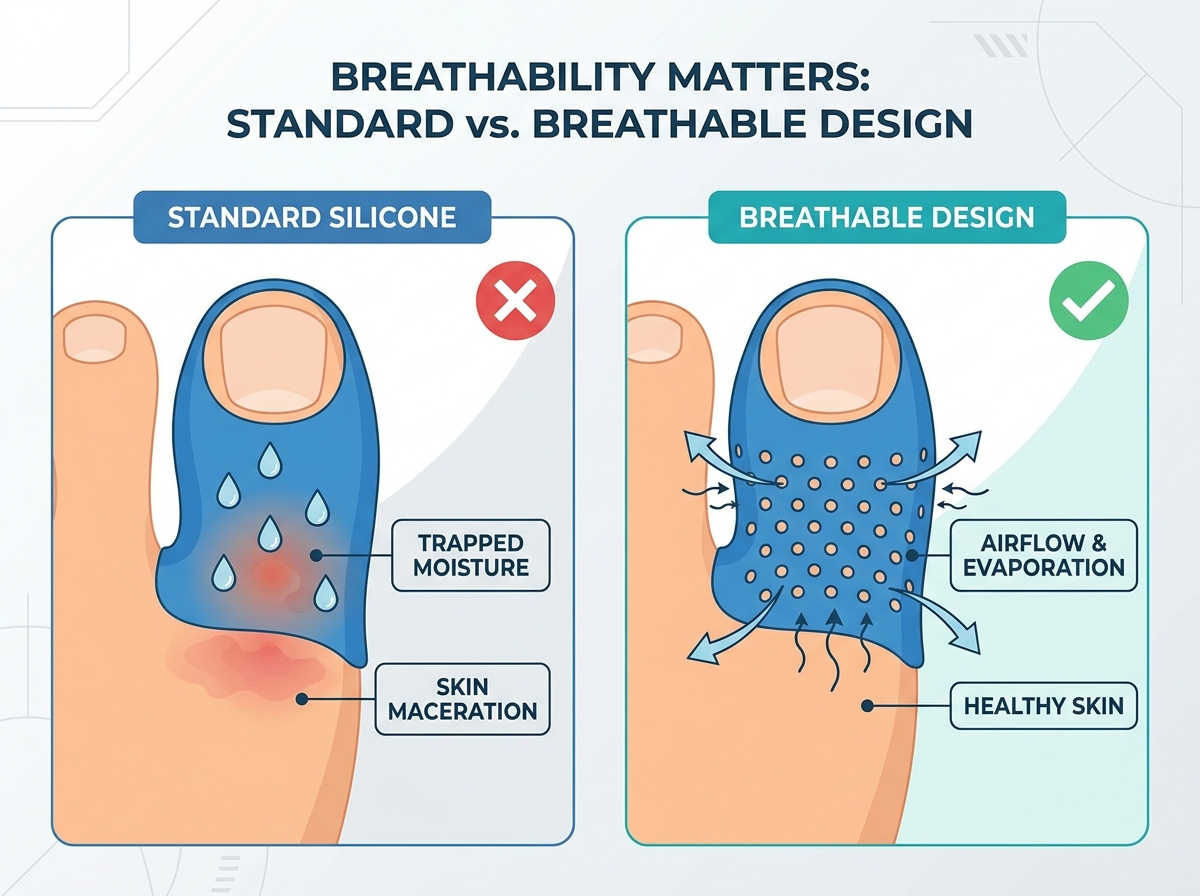
While traditional silicone toe sleeves offer excellent friction reduction, they often introduce an entirely new problem: trapped moisture and rapid skin maceration. Users quickly discover sweat buildup ruins an otherwise perfect cushioning tool. For individuals managing chronic foot conditions or high-impact athletic friction, balancing joint protection against optimal skin health remains the primary barrier to long-term wear. Without proper ventilation, the epidermis softens continuously. This creates a dark, damp environment ripe for severe blisters and stubborn fungal infections.
Evaluating breathable toe sleeves requires understanding underlying material science, precise sizing mechanisms, and condition-specific applications. You must balance impact absorption against moisture evaporation to ensure effective, comfortable relief. This comprehensive guide explores how advanced sleeve designs overcome the inherent limitations of closed-cell silicone. We will examine practical strategies to deliver sustained structural protection and superior daily foot hygiene.
Standard medical silicone utilizes a closed-cell structure. It provides incredible durability and excellent shear-force reduction. However, it entirely prevents sweat evaporation. When you enclose a digit in solid silicone, the local temperature rises rapidly. Sweat accumulates against the skin barrier. The epidermis absorbs this trapped moisture over several hours. We refer to this continuous softening process as skin maceration. Macerated skin turns white, wrinkles heavily, and loses its structural integrity. It tears easily under normal walking pressure. Furthermore, this damp microclimate actively encourages aggressive bacterial and fungal growth. You notice these negative effects most during long-distance running or full workday wear.
Manufacturers solve the moisture trap through two distinct design approaches.
A high-quality sleeve must execute a delicate balancing act. It must reduce sheer forces effectively through adequate gel cushioning. Simultaneously, it must maintain a stable microclimate. It must keep the outer epidermis completely dry. You achieve success when the sleeve protects the underlying joint without compromising surface skin health.
Hammer toe conditions elevate the proximal interphalangeal (PIP) joint abnormally. The rigid shoe upper constantly rubs against this raised knuckle during the gait cycle. This repetitive friction creates painful corns and deep calluses. Effective hammer toe treatment without surgery relies on consistent daily protection. You must physically shield the PIP joint from exterior materials. Because symptom management requires prolonged, all-day wear, breathability becomes a non-negotiable feature. Solid silicone degrades the skin over a twelve-hour shift. Ventilated sleeves defend the joint while preserving the skin layer.
Recovering from a minor fracture requires careful stabilization. You typically isolate the healing digit or buddy-tape it to an adjacent toe. A breathable sleeve separates the digits comfortably. It provides an excellent buffer against accidental bumps. Safe broken toe treatment at home demands strict moisture control. Post-injury swelling happens naturally. Trapped moisture around a swollen, compromised digit complicates the healing timeline. It increases infection risks significantly. Breathable designs offer much safer stabilization by allowing localized heat to dissipate quickly.
Bunions create intense side-friction on the first metatarsophalangeal (MTP) joint. Conventional silicone guards often slide around inside the shoe. Foot sweat exacerbates this unwanted movement. We call this the "sweaty slip" effect. Reliable bunion relief at home requires absolute stability. Evaluating full wrap sleeves versus basic spacers reveals a clear winner. Breathable wrap designs anchor themselves securely. The perforations prevent sweat accumulation, ensuring the silicone grips the skin firmly. They maintain their protective position without slipping.
An improper fit instantly negates the benefits of breathable materials. A sleeve stretched too tightly restricts necessary blood flow. It also forces sweat directly back against the skin layer. Extreme tension stretches the ventilation holes closed, rendering them useless. Conversely, a sleeve fitted too loosely folds and bunches inside the sock. The resulting material friction causes painful secondary blisters. Sizing accuracy dictates product performance.
We recommend a strict three-step protocol to ensure optimal fit and function.
Consulting a reliable toe wrap sizing guide before purchase eliminates frustrating trial and error.
| Size Category | Target Anatomy | Typical Circumference (Inches) | Primary Application |
|---|---|---|---|
| Large / Wide | Big toe (Hallux) | 2.5" - 3.5" | Bunion shielding, large joint protection |
| Medium | Middle toes (Digits 2-4) | 1.5" - 2.5" | Hammer toe defense, buddy taping |
| Small / Narrow | Pinky toe (Digit 5) | 1.0" - 1.5" | Tailor's bunion, tight shoe friction |
You must scrutinize the exact material composition. Look exclusively for medical-grade silicone. It should explicitly state it is hypoallergenic. Ensure the manufacturer guarantees a BPA-free and latex-free product. These specific certifications prevent severe contact dermatitis. Chemical irritants combined with slight friction create disastrous skin reactions. Always prioritize certified materials over cheaper, generic alternatives.
Your daily activity level dictates the necessary design features.
Assess the expected lifespan of perforated silicone critically. Poorly manufactured holes create structural weaknesses. They tear easily after a few uses. Check the edges for reinforced molding. You must also evaluate washability criteria. Proper maintenance extends product life. Wash them gently using warm water and mild, unscented soap. Always let them air dry completely. Never expose them to extreme direct heat.
| Material Type | Breathability Rating | Cushioning Level | Best Use Case |
|---|---|---|---|
| Standard Solid Silicone | Poor | Maximum | Short duration (<2 hours) |
| Perforated Silicone | High | Moderate | Athletics, all-day wear |
| Fabric-Lined Gel | Excellent | Targeted/Variable | Everyday footwear, office shoes |
New users often face a brief break-in period. The skin requires time to adjust to a new microclimate. We strongly advise a gradual increase in wear time. Start by wearing the sleeve for just one or two hours. Remove it and monitor your skin response closely. Look for unusual redness or deep indentations. Gradually increase the duration over a full week to prevent unexpected irritation.
You must recognize when to avoid these products entirely. Never apply a silicone sleeve over open wounds or healing cuts. Avoid them strictly during active fungal infections, such as Athlete’s foot. A closed environment exacerbates these issues rapidly. Severe peripheral neuropathy demands extreme caution. Diabetic patients lack necessary pain sensation in their extremities. They should always consult a podiatrist before using any compressive sleeves to avoid undetected circulation restriction.
Maintain realistic expectations regarding treatment outcomes. Acknowledge these breathable sleeves as conservative management tools. They excel at defending against friction and relieving immediate pain. However, they do not function as curative interventions. They cannot fix underlying biomechanical faults. You will not achieve permanent structural realignment of severe bone deformities using surface-level padding alone.
Balancing joint protection and skin hygiene requires careful product selection. Prioritize breathable, perforated designs over solid silicone tubes whenever possible. Apply this shortlisting logic strictly if your wear time exceeds two hours daily. You must also insist on ventilation for any athletic or high-impact activity. Solid silicone simply traps too much moisture for prolonged use.
Take actionable steps today to improve your comfort. First, measure your toe circumference accurately at the end of the day. Second, identify your primary friction points to determine the necessary gel thickness. Finally, select a mixed-size starter pack. Test multiple sizes in your standard footwear to find the perfect anatomical fit. Proper sizing combined with advanced breathable materials delivers lasting, complication-free relief.
A: We recommend a safe wear window of 8 to 12 hours maximum. You must remove the sleeve afterward to let your skin rest. Continuous encapsulation eventually traps some moisture, even with advanced perforated designs. Always take them off before sleeping unless directed otherwise by a qualified healthcare professional.
A: No. They provide excellent symptom relief and strong friction defense. They effectively stop corns and blisters from forming. However, they cannot structurally realign bone deformities. You must pursue surgical correction to fix the underlying anatomical issue. Sleeves remain a strictly conservative management tool.
A: Gently wash the sleeve by hand. Use lukewarm water and a mild, unscented soap. Avoid harsh chemical cleaners completely. Do not scrub the ventilation holes aggressively, as this causes material tearing. Rinse it thoroughly and let it air dry. Dust it lightly with talcum powder to restore smoothness.
A: Yes, but consider aesthetics and slip risks carefully. Transparent or flesh-toned silicone blends in reasonably well. Because they lack sock encapsulation, ensure your fit is perfectly snug. A properly sized sleeve grips the skin gently, preventing it from sliding off while walking in sandals.


