
English 
T: +86-18251114333
E: kingleo_sz@126.com
E: kingleo_sz@126.com
3rd Floor, Building 2, No. 338 Jiangzhuang Road, Guoxiang Street, Wuzhong District, Suzhou City
Views: 0 Author: Site Editor Publish Time: 2026-10-16 Origin: Site


Living with foot deformities often prompts a single, overriding goal: halting the progression while avoiding invasive procedures. When a toe begins to curl unnaturally, immediate action can preserve joint function. Conservative care works remarkably well during the early, flexible stage of this condition. However, it cannot mechanically reverse a joint that has already become rigid and arthritic. Recognizing this critical distinction saves you time, money, and unnecessary discomfort.
The purpose of this guide is to provide an evidence-based framework for evaluating your condition. We will explore proven at-home treatments, analyze various orthotic devices, and highlight proper fitting techniques. By understanding your baseline, you can choose supportive wearables and interventions that genuinely improve your daily mobility. You will learn how to select the right materials, measure for a perfect fit, and know exactly when it is time to seek professional medical intervention.
Identifying the correct stage of your toe deformity remains the most crucial step before attempting any intervention. Medical professionals categorize these deformities into two distinct phases. Understanding your current phase helps you set realistic success criteria. It also prevents you from attempting treatments that could worsen your symptoms.
During the flexible stage, the affected joint still moves. You can manually straighten the curled toe using your fingers. If you catch the condition here, conservative care proves highly effective. Your primary success criteria should focus on pain reduction. You also want to halt further progression and maintain your current joint mobility. Supportive devices and targeted physical therapy can physically realign a flexible joint during daily activities.
Eventually, untreated tendon imbalances cause the joint to fuse. When a hammer toe reaches the rigid stage, the joint becomes highly arthritic. You can no longer straighten the toe manually. At this point, non-surgical realignment is anatomically impossible. Your success criteria must shift entirely. Focus on friction management and ulcer prevention. You must protect the prominent knuckle from rubbing against your footwear.
You must practice extreme caution if your joint has become rigid. Do not attempt aggressive at-home straightening on fused joints. Forcing a rigid toe into a straight splint causes severe micro-trauma to the surrounding ligaments. It can also trigger aggressive bursitis. Always assess joint flexibility before applying any corrective device. If the toe resists gentle pressure, prioritize padding over realignment.
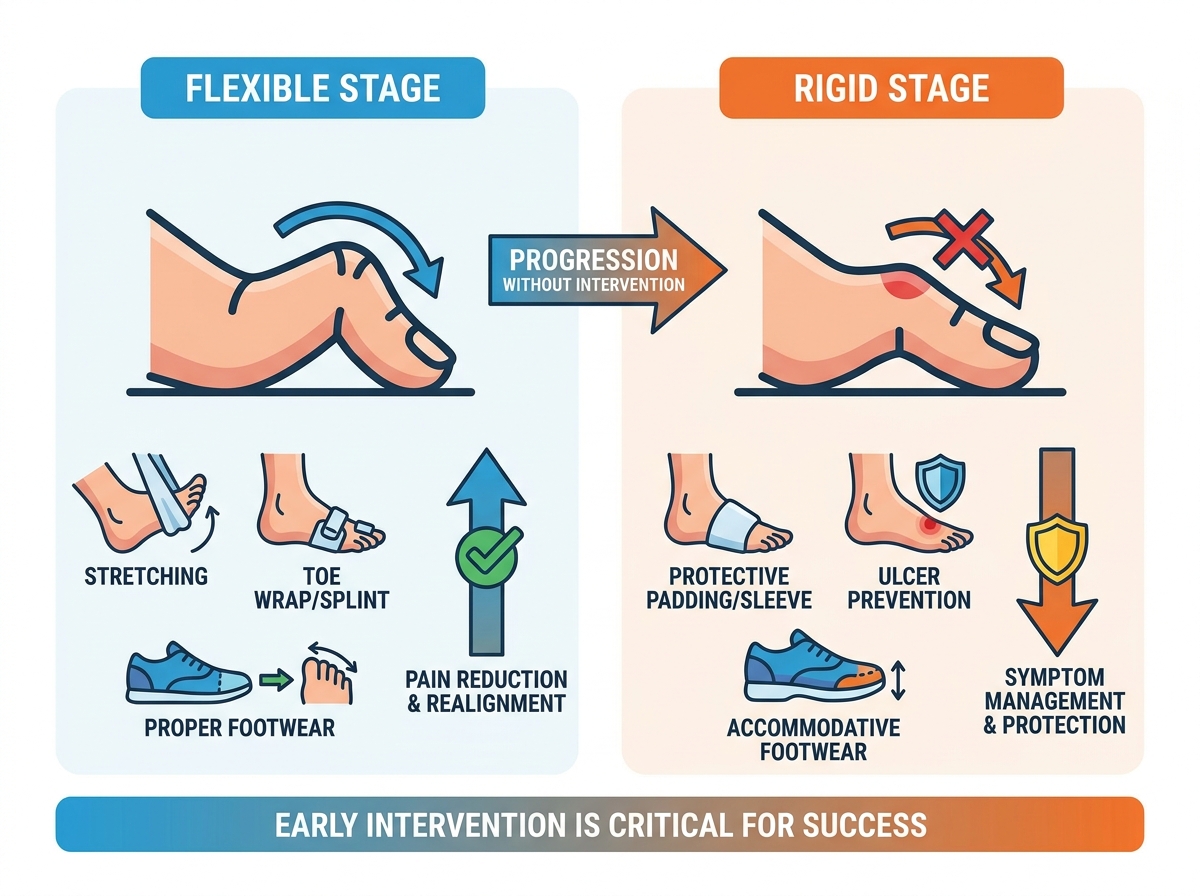
Effective hammer toe treatment without surgery relies on a multi-layered approach. You cannot rely on a single tool to manage complex foot mechanics. Instead, combine proper footwear, active strengthening, and targeted joint stabilization.
Your shoes act as the foundation for all foot health. Even the best treatments fail if you continue wearing restrictive footwear. When evaluating your daily shoes, look for three specific criteria. First, ensure a wide toe box. Your toes need room to splay naturally without overlapping. Second, look for deep depth. A curled toe sits higher than normal toes. Shallow shoes create immediate top-down friction. Finally, select shoes with low heels. High heels force your body weight forward, exacerbating the tendon imbalance that causes toe deformities.
Muscle imbalances drive this condition. The extensor tendons on top of your foot overpower the flexor tendons underneath. You must strengthen your intrinsic foot muscles to restore balance. Two simple exercises yield excellent results:
Many foot deformities share similar biomechanical roots. The toe spacing and joint offloading principles used here directly translate to other conditions. For instance, properly separating the digits simultaneously delivers effective bunion relief at home. It reduces the lateral pressure pushing the big toe inward. Furthermore, stabilizing a flexible deformity mimics the immobilization required for broken toe treatment at home. Tools like buddy tape serve dual purposes across these overlapping foot issues.
The market offers countless devices claiming to fix foot deformities. You must evaluate these tools critically based on your daily lifestyle and specific anatomical needs. Understanding the categories helps you make an informed choice.
Patients typically choose between four main device categories. Crest pads sit beneath the toes, lifting the tips to relieve distal pressure. Gel toe separators sit between the digits to prevent overlapping. Buddy tapes bind a weak toe to a stronger neighbor for stability. Finally, compression sleeves slide over the toe to provide 360-degree friction protection.
When selecting a support device, evaluate it across three specific dimensions:
Support Device Evaluation Criteria
| Device Type | Primary Material | Best Use Case | Shoe Compatibility |
|---|---|---|---|
| Crest Pads | Silicone / Felt | Relieving pressure on toe tips | Excellent in deep shoes |
| Toe Separators | Soft Gel | Preventing overlapping toes | Good in wide toe boxes |
| Buddy Tape | Fabric Adhesive | Stabilizing flexible joints | Excellent in all shoes |
| Compression Sleeves | Breathable Fabric / Gel | All-around friction protection | Excellent in most shoes |
We must establish a transparent clinical assumption. Wearable sleeves and pads manage symptoms. They effectively prevent friction, reduce pain, and slow down progression. However, they do not mechanically cure the underlying tendon imbalance. Do not expect an orthotic device to permanently reverse your anatomy once you take it off.
A poorly fitted device causes more harm than good. If a wrap is too tight, it causes venous pooling and restricts blood flow. If it compresses a nerve, you will experience sharp, shooting pains. Following a precise toe wrap sizing guide ensures safe, effective daily wear.
You cannot guess your size based on your shoe size. Toes vary wildly in circumference. Follow these exact steps to determine your correct measurement:
Once you receive your wrap or sleeve, you must verify the fit. Use two clinical tests to ensure safety.
First, perform the capillary refill test. Apply the wrap to your toe. Press down firmly on your toenail until the nail bed turns white. Release the pressure immediately. Count the seconds. The nail bed should return to a healthy pink color within two seconds. If it takes longer, the wrap is restricting your arterial blood flow. You must size up.
Second, perform the tug test. Put on the wrap and gently tug the end. It should provide mild resistance without sliding right off. If it slips easily during a gentle tug, it will migrate during your natural walking gait. A loose sleeve bunches up inside your shoe, creating new friction points.
Conservative care forms the bedrock of foot health. However, you must recognize when at-home management reaches its absolute limit. Prolonging ineffective treatments can lead to severe secondary complications.
Determine your timeline for success. If you have consistently utilized wide footwear, performed tendon stretches, and worn properly sized breathable sleeves for three months without pain reduction, your condition requires escalation. Chronic pain that alters your walking gait often leads to knee and hip issues.
Watch closely for these specific warning signs. Their presence dictates an immediate shift from conservative care to professional medical intervention:
When you encounter these red flags, transition your care plan. Consult a board-certified podiatrist or orthopedic foot surgeon. You do not necessarily need a massive reconstructive surgery. Modern medicine offers minimally invasive options. A simple, in-office percutaneous tenotomy can release the tight tendon. For arthritic joints, a minor joint arthroplasty removes the prominent bone spur. These procedures offer rapid recovery times compared to traditional open surgeries.
Managing a curling toe deformity requires a strategic, layered approach. You must first assess whether your joint remains flexible or has become rigid. This dictates your entire treatment philosophy. Prioritize foundational changes by investing in footwear featuring a wide toe box and deep depth. Support your physical therapy efforts by utilizing properly sized breathable sleeves to mitigate daily friction.
Never underestimate the importance of exact measurements. Using a standardized measurement protocol protects your circulation and nerve health. Monitor your feet daily for red flags like ulcers or sudden rigidity. If conservative tools fail to manage your pain after a few months, consult a specialist to explore minimally invasive corrections. Take action today. Measure your toe in the late afternoon, select a clinically appropriate wrap, and begin your journey toward comfortable, pain-free mobility.
A: No, it will not straighten out naturally. This condition stems from a progressive tendon imbalance. The extensor tendons pull incorrectly against the flexor tendons. Without active intervention, such as footwear modification or physical therapy, the imbalance worsens over time and eventually forces the joint to fuse rigidly.
A: Start gradually to build skin tolerance. Wear the wrap for just two hours on the first day. Inspect your skin for severe redness or irritation. Increase the duration by one hour each subsequent day. Once broken in, you can safely wear properly fitted wraps for 8 to 12 hours during active daytime hours.
A: Yes, buddy taping effectively stabilizes a flexible joint by tethering it to a stronger, straight neighbor. It prevents the weak digit from curling further during gait. This offloading principle is highly effective and closely mirrors the stabilization techniques widely used for fractured digits.
A: Toe separators provide excellent symptom relief by preventing interdigital friction and gently stretching tight tendons. However, they do not anatomically reverse the underlying deformity. They manage the condition, relieve pain, and slow progression, but the toe will return to its curled state once the separator is removed.


