
English 
T: +86-18251114333
E: kingleo_sz@126.com
E: kingleo_sz@126.com
3rd Floor, Building 2, No. 338 Jiangzhuang Road, Guoxiang Street, Wuzhong District, Suzhou City
Views: 0 Author: Site Editor Publish Time: 2026-10-16 Origin: Site


Selecting a toe wrap is never a simple, one-size-fits-all process. The wrong fit can exacerbate joint pain, restrict vital circulation, or significantly delay your recovery. Many buyers simply guess their size based on standard shoe measurements. However, whether you are recovering from an acute injury or managing a chronic structural deformity, you must balance firm compression alongside everyday comfort. A poor choice often leads to frustrating setbacks and increased discomfort.
Our goal is to provide a comprehensive, clinical-grade framework for measuring your toes accurately. We will help you evaluate various material types and determine the ideal fit for your unique anatomy. You will learn exactly how to select the optimal size needed for your specific foot condition. Say goodbye to guesswork and painful footwear. Read on to master the sizing process and protect your long-term foot health.
Understanding the fundamental biomechanics of a poor fit is crucial. Oversized wraps fail to properly immobilize damaged joints. They allow excessive micro-movements during walking. This dangerous instability prevents fractured bones or strained ligaments from fusing correctly. You lose the primary benefit of the device entirely. Conversely, undersized wraps aggressively compress digital nerves and blood vessels. Tight fits choke off necessary oxygen flow to the extremity. You risk permanent nerve damage if you ignore this compression.
Secondary complications arise quickly from improperly sized orthopedic devices. Friction-induced blisters represent a major setback for patients. Loose wraps rub constantly against sensitive skin inside your shoes. They tear the epidermal layers, inviting serious bacterial infections. Furthermore, compromised healing timelines often result from these avoidable wounds. Instead of healing a simple strain, you end up treating infected blisters. This domino effect prolongs your overall recovery period. Reading a reliable toe wrap sizing guide prevents these cascading medical issues.
You must also set realistic expectations regarding what wraps can achieve. Correctly sized devices manage painful symptoms efficiently. They also prevent existing deformities from progressing further. However, they are not miraculous surgical cures. Orthopedic supports cannot permanently dissolve bone spurs or magically reset severe anatomical abnormalities. They serve as exceptional conservative management tools. Use them to maintain daily mobility and reduce chronic discomfort.
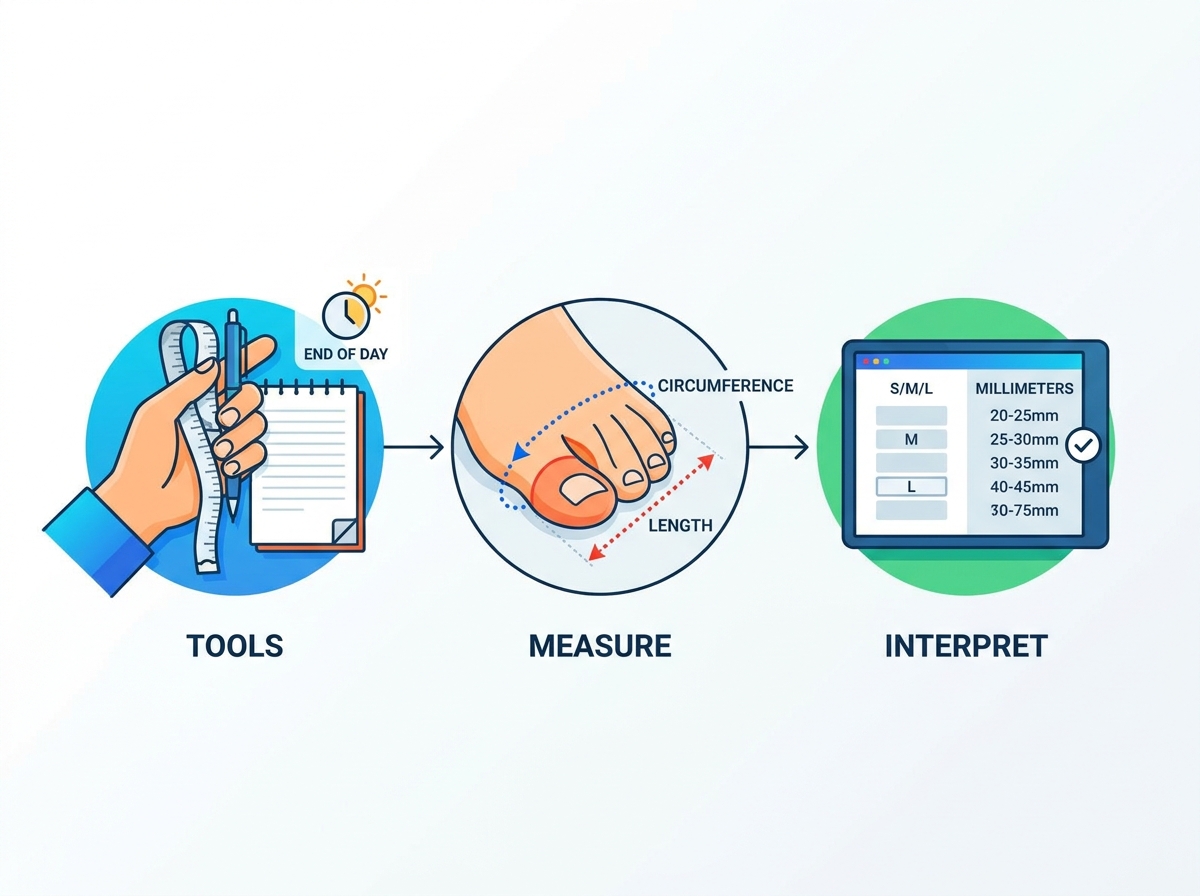
Proper measurement prevents costly sizing errors. You need precise anatomical data to choose a comfortable support. Let us look at the exact steps required for success.
First, gather the right tools before you begin. You need a soft measuring tape, a pen, and some paper. Do not use metal construction tape. It cannot wrap tightly around small, curved digits.
Timing your measurement heavily influences overall accuracy. We highly recommend measuring your feet at the end of the day. Feet naturally swell after hours of standing or walking. Taking measurements during peak swelling ensures your wrap will not feel too tight during maximum activity. A morning measurement often leads to an undersized purchase.
Here is how you capture the essential measurement metrics accurately:
Interpreting sizing charts requires careful attention to detail. Standard matrices use simple Small, Medium, and Large categories. These broad brackets often overlap significantly. In contrast, premium medical brands provide precise millimeter measurements. Always cross-reference your exact circumference numbers against the brand's specific chart. Ignore your standard shoe size entirely. Footwear sizes do not correlate accurately with individual toe thickness.
Different ailments require entirely unique sizing strategies. A device used for a fracture behaves differently than one treating chronic misalignment.
Executing safe broken toe treatment at home frequently involves buddy wrapping. This technique requires binding the injured digit securely to a healthy adjacent toe. Your sizing logic must accommodate the combined width of both toes. The wrap should never pinch the delicate interdigital space between them. If the material digs into the webbing, it is too narrow. A proper buddy wrap distributes pressure evenly across both digits. This stabilizes the fracture while maintaining healthy blood flow.
Effective hammer toe treatment without surgery relies heavily on splint wraps. The sizing logic here focuses specifically on downward pressure. A hammer toe points unnaturally upward at the middle joint. Your wrap must be long enough to anchor firmly beneath the metatarsal pad. It then needs to fit securely over the proximal interphalangeal (PIP) joint. If the wrap is too short, it will slip off the joint during movement. It must supply consistent, gentle traction to keep the toe flat.
Achieving meaningful bunion relief at home requires spacers or specialized sleeves. The sizing logic demands a wider overall profile. You need enough leverage to stretch the big toe gently outward. Focus closely on the thickness of the lateral padding. You must also ensure the loop diameter comfortably accommodates your big toe. A loop that is too tight will cut off circulation instantly. The spacer should sit flush against the bunion without causing excessive shoe friction.
Material choice directly impacts therapeutic effectiveness. You must evaluate stretch profiles carefully before purchasing. Medical-grade silicone offers high stretch and high friction. It stays firmly in place but can sometimes trap heat. Conversely, nylon and spandex blends deliver moderate stretch with low friction. They glide easily inside tight socks and shoes.
We highly recommend using breathable toe sleeves for your daily activities. Moisture-wicking properties are strictly non-negotiable for all-day wear. Feet sweat naturally inside closed-toe shoes. Trapped moisture creates an ideal breeding ground for painful fungal infections. Breathable fabrics pull this moisture away from the skin. They keep your toes dry and prevent severe skin maceration.
You must also calculate shoe compatibility and toe box depth. A wrap adds noticeable volume to your foot profile. Test whether your current footwear offers enough toe box width to accommodate this extra bulk. If the shoe presses aggressively down on the splint, you will experience severe pain. Always remove the factory insoles if you need a fraction more vertical space.
Comparison of Toe Wrap Materials| Material Type | Stretch Capacity | Friction Level | Best Used For |
|---|---|---|---|
| Medical-Grade Silicone | High | High (grips skin tightly) | Spacers, bunion shields, barefoot wear |
| Nylon/Spandex Blend | Moderate | Low (slides easily) | Breathable sleeves, closed-toe shoes |
| Rigid Splints (Velcro/Plastic) | Low | Moderate | Fracture immobilization, nighttime recovery |
Even carefully chosen wraps sometimes fit poorly. You must recognize the physical warning signs quickly. Remove the device immediately if you spot any of these dangerous indicators.
You can easily check for healthy blood flow using this clinical test. Press down firmly on the tip of the wrapped toe until the skin turns white. Release the pressure and time the color return. Healthy pink tissue should return within two seconds. If the toe remains pale or turns slightly blue, your wrap is dangerously tight.
This sensation serves as the primary indicator of severe nerve compression. A wrap that is too small pinches the delicate digital nerves. You might feel a "pins and needles" sensation shortly after application. Never ignore this symptom. It means the wrap is suffocating your nerve pathways.
Observe how the support behaves when you walk naturally. A wrap that slides up or down the toe lacks adequate grip. It might simply be too large. Constant migration renders the device entirely useless. It also drastically increases your risk of developing painful friction blisters.
Sometimes you can adjust a device to fit better. It is usually safe to trim the edges of a solid silicone wrap using sharp scissors. You can customize the length without ruining the product. However, modifying a woven fabric sleeve is highly dangerous. Cutting fabric compromises its structural integrity entirely. It will unravel rapidly during washing. If a fabric wrap does not fit out of the box, you must exchange it for a different size.
Choosing the correct size sits squarely at the intersection of accurate measurement, condition-specific needs, and proper material stretch. You cannot rely on mere guesswork. Using our clinical framework ensures your joints heal safely while maintaining daily comfort.
Take action by shortlisting your next steps today. First, measure your feet tonight when they are naturally swollen. Then, check your exact numbers against brand-specific sizing charts. Always prioritize purchasing products that offer clear, hassle-free return policies if the initial fit isn't absolutely perfect.
Finally, critically evaluate your current footwear options. Ensure your favorite shoes have a wide enough toe box to accommodate the added volume of a supportive device. Browse condition-specific wrap categories today and take the crucial first step toward lasting foot relief.
A: Yes, consider dynamic sizing based on your condition. Acute injuries usually trigger significant, temporary swelling. Sizing up accommodates this inflammation safely. For chronic conditions, measure at the end of the day to capture your baseline daily swelling.
A: You can, but nighttime sizing differs from daytime needs. Your feet do not bear weight or swell as much in bed. Some users prefer slightly snugger rigid splints at night, while using highly flexible sleeves during daytime weight-bearing activities.
A: Medical guidelines suggest a "snug but not restrictive" baseline. The wrap must immobilize the broken digit alongside the healthy one securely. However, it should never cause throbbing, pale skin, or indentations on your webbing.
A: Yes, material degradation happens naturally. Spandex sleeves and silicone spacers lose their elasticity after repeated stretching and washing. You should replace them every three to six months to guarantee consistent, effective joint support.


