
English 
T: +86-18251114333
E: kingleo_sz@126.com
E: kingleo_sz@126.com
3rd Floor, Building 2, No. 338 Jiangzhuang Road, Guoxiang Street, Wuzhong District, Suzhou City
Views: 0 Author: Site Editor Publish Time: 2026-10-16 Origin: Site


A sudden stubbed toe can bring your daily routine to a painful halt. We often ignore toe injuries, hoping the throbbing will just fade away overnight. While many toe fractures do not need surgery, ignoring them remains a serious mistake. Improper care can cause long-term chronic pain, joint stiffness, or permanent bone misalignment.
You need a reliable plan to heal properly and get back on your feet safely. This guide outlines how to handle a broken digit effectively. We will show you how to evaluate the injury and when you should see a doctor. You will learn the best immobilization techniques to keep the healing bones straight. We also cover how to choose the right recovery products and what recovery timeline to expect. Finally, we explore how proper stabilization tools provide extra benefits for your overall foot mechanics.
Patients must accurately evaluate their injury right away. Skipping this step often leads to long-term physical and financial costs. An untreated severe fracture can trigger chronic arthritis. You might eventually need custom orthotics or even corrective surgery. You must know if you can safely manage the break yourself.
Not every broken toe requires a trip to the emergency room. You can often manage the injury yourself if it meets specific criteria. Home care is generally safe when:
You must also recognize the warning signs of a severe injury. Do not attempt to treat the injury yourself if you spot red flags. Seek immediate professional podiatric evaluation if you experience numbness, tingling, or any loss of circulation. These symptoms often point to nerve damage or compromised blood flow.
Furthermore, never attempt to treat a suspected big toe (hallux) fracture by yourself. Your big toe bears the brunt of your walking mechanics. It handles massive force every time you push off the ground. Big toe injuries almost always require rigid walking boots, specialized casting, or surgical pins to heal correctly.
Common Mistake: People often assume they can walk off a crooked toe. If the bone looks visibly angled, do not try to snap it back into place. You risk severing tendons or blood vessels.
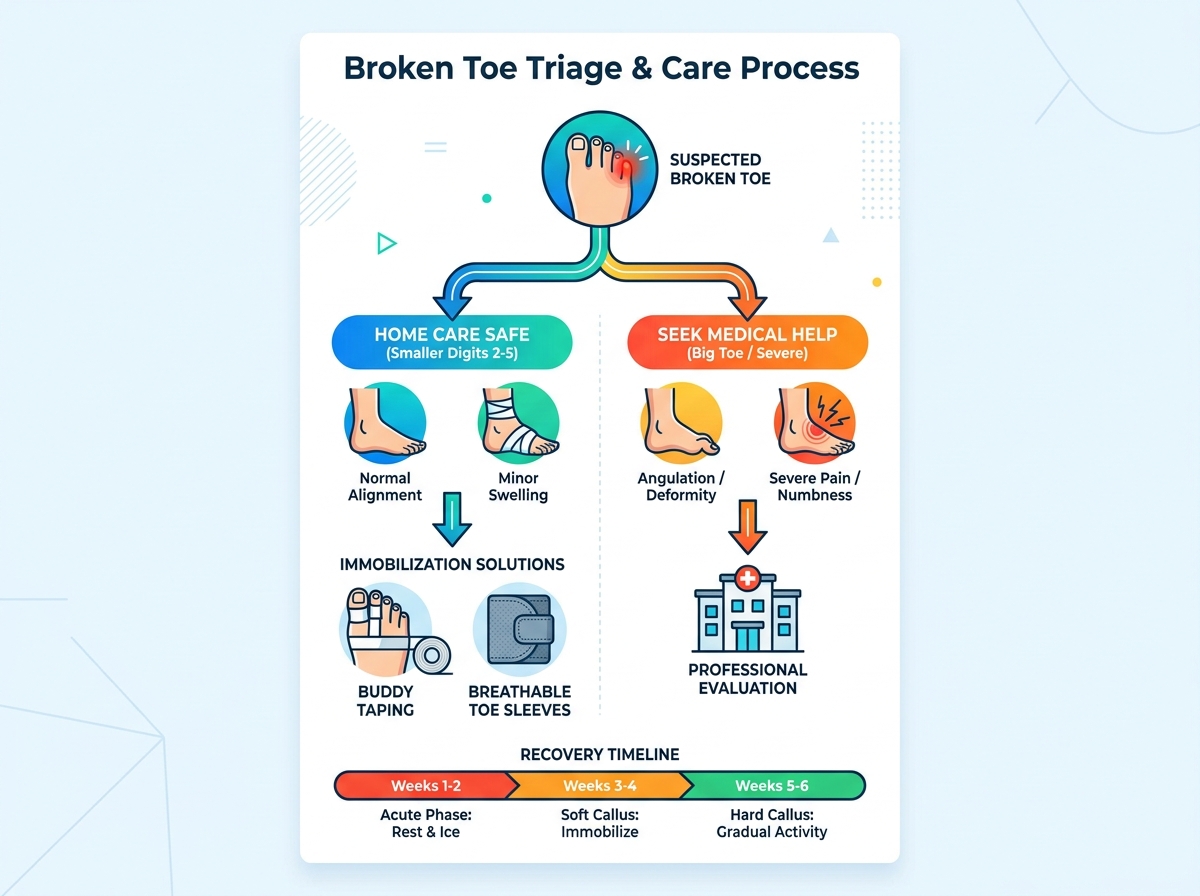
A structured approach ensures your bones heal correctly. When executing broken toe treatment at home, immediate action dictates your overall recovery success. You must minimize inflammation and stabilize the joint immediately.
You must prioritize rest and elevation during the first 48 hours. Minimize all weight-bearing activities. Propping your foot above heart level reduces vascular throbbing. Gravity helps drain excess fluid away from the injured tissues. This simple step drastically reduces acute pain.
Structured icing acts as your primary defense against severe swelling. Apply an ice pack for 15 to 20 minutes every one to two hours. You must observe one critical precaution: never apply ice directly to bare skin. Always wrap the ice in a thin towel. Direct contact causes frostbite and damages delicate skin structures.
Buddy taping remains the gold standard for stabilizing minor toe fractures. You simply tape the injured toe to the adjacent healthy toe. The healthy toe acts as an anatomical splint. It prevents the broken bone from shifting during movement.
However, traditional buddy taping carries notable implementation risks. Standard athletic tape often causes intense skin irritation. It traps moisture from sweat, creating a breeding ground for bacteria. Furthermore, wrapping the tape too tightly cuts off vital circulation. You might wake up to a purple, throbbing toe. You need better materials for long-term recovery.
Upgrading from standard medical tape to commercial toe wraps transforms the healing process. These modern solutions offer superior comfort and adjustability over a long recovery period. You must evaluate these products based on specific criteria to ensure safe healing.
Material breathability stands out as the most critical feature. When you bind two toes together, sweat quickly accumulates in the tight space. Opting for breathable toe sleeves prevents fungal growth and skin maceration. Maceration occurs when trapped moisture breaks down skin tissue, leaving you vulnerable to severe infections.
Adjustability provides another major advantage. Your injured toe will swell and shrink daily based on your activity level. Hook-and-loop closures accommodate these daily swelling fluctuations perfectly. Slip-on silicone sleeves offer excellent comfort but lack precise tension control. You should choose hook-and-loop designs for the turbulent early stages of recovery.
Comparison of Toe Immobilization Materials
| Material Type | Breathability | Adjustability | Ideal Use Case |
|---|---|---|---|
| Standard Athletic Tape | Low | None (Must reapply) | First 24 hours emergency splinting |
| Silicone Slip-on Sleeves | Medium | Low | Late-stage recovery, low swelling |
| Hook-and-Loop Fabric Wraps | High | High | Weeks 1-4, daily swelling changes |
Selecting the wrong size renders the wrap useless. Consulting a proper toe wrap sizing guide ensures the product you choose applies the correct amount of anatomical compression.
A broken toe does not happen in isolation. It often interacts with existing foot deformities. The altered walking mechanics can exacerbate underlying structural problems. Fortunately, the recovery tools you use offer dual benefits.
The stabilization wraps used for fractures provide excellent secondary benefits. They effectively support hammer toe treatment without surgery by gently encouraging proper anatomical alignment. The wraps hold the joint straight, preventing the tendons from contracting further during the healing phase.
You can also achieve impressive bunion relief at home while protecting your fractured digit. Properly sized sleeves and toe separators shield the foot from lateral shoe pressure. They create essential space between the toes. This reduces the agonizing friction bunions usually cause during the gait cycle.
We must set realistic expectations regarding these secondary benefits. Wraps and sleeves alleviate painful symptoms and stabilize foot mechanics perfectly. However, they do not permanently cure underlying bone deformities. You cannot reverse a severe bunion simply by wearing a toe sleeve. They act as excellent conservative management tools, but severe structural issues ultimately require podiatric intervention.
Bone healing follows a strict biological schedule. You cannot rush the process. Understanding each stage helps you manage expectations and avoid re-injury.
Weeks 1-2: Acute Phase. You will experience maximum swelling and bruising. Pain peaks during weight-bearing activities. You must wear rigid, wide-toe shoes. The stiff sole prevents the toe joints from bending when you walk. Keep the toe wrapped continuously.
Weeks 3-4: Soft Callus Formation. Your body lays down a fibrous soft callus over the break. Pain decreases significantly. You might feel tempted to stop taping. Do not discard the wrap yet. The soft callus remains fragile. Immobilization is still absolutely necessary to prevent the bone from snapping back out of alignment.
Weeks 5-6: Hard Callus Formation. The bone calcifies into a hard callus. You can begin gradual weaning off the toe wraps. Start by removing the wrap during low-impact activities at home.
Expect some residual stiffness. Your joint just spent six weeks completely immobilized. The ligaments will feel tight. You should test your weight-bearing limits safely. Start with short walks around your house.
Do not jump straight back into high-impact activities. Running, jumping, or sports place immense stress on the digits. Wait until you have zero pain during normal walking and no lingering tenderness when pressing the bone. You can discard the wrap completely only when the toe feels structurally solid and visually normal.
Effective recovery from a broken digit requires prompt immobilization, proper daily hygiene, and the right supportive materials. You control the outcome by taking immediate action and respecting the biological healing timeline.
For your next steps, we recommend measuring your toe immediately to order a proper fabric wrap. Switch to a stiff-soled shoe to protect the joint from bending. Monitor the injured area closely for the first 48 hours to confirm home care remains appropriate.
Finally, always prioritize your long-term mobility. Consult a podiatrist immediately if your pain suddenly worsens, swelling does not subside after a week, or you notice any visual deformity.
A: Yes, but it should be limited. Use a stiff-soled shoe to prevent the toe joint from bending, and rely on a toe wrap for stability.
A: Typically 3 to 6 weeks, depending on the severity of the fracture. It should be worn during all weight-bearing activities.
A: Yes. Tape can trap moisture and lose grip. Breathable sleeves offer reusable, adjustable compression and reduce the risk of skin breakdown between the toes.
A: The non-surgical immobilization tools like splints and wraps used for breaks are the same tools used for conservative hammer toe management. They can potentially provide simultaneous symptomatic relief.


