
English 
T: +86-18251114333
E: kingleo_sz@126.com
E: kingleo_sz@126.com
3rd Floor, Building 2, No. 338 Jiangzhuang Road, Guoxiang Street, Wuzhong District, Suzhou City
Views: 0 Author: Site Editor Publish Time: 2026-10-16 Origin: Site


Bunion pain is progressive. It can severely disrupt your daily mobility. Every step becomes a sharp reminder of the issue. The metatarsophalangeal joint bears immense pressure during walking. While surgery remains the only way to permanently correct this bone deformity, operations require significant recovery time. Ignoring the problem only accelerates the structural shift. Fortunately, conservative daily management can significantly reduce pain and slow progression.
You have real power to alter your daily comfort levels. This article delivers a practical, evidence-based guide to evaluating home treatment options. We explore how to select the exact right support devices for your lifestyle. You will learn to manage overlapping foot conditions safely. You will discover the exact footwear modifications necessary for success. We examine targeted joint support techniques. Finding effective relief requires targeted action. Regain control over your daily mobility today.
Diagnostic clarity forms the foundation of effective home care. You must differentiate between structural deformities and acute injuries. Bunions develop gradually over many years. The big toe pushes inward toward the second toe. The joint at the base pushes outward. This creates a bony bump on the side of your foot. You must establish a safe baseline before beginning treatment. Do not mistake a chronic biomechanical shift for a sudden injury. Proper diagnosis prevents accidental harm. It ensures you apply the correct interventions.
Overlapping foot issues frequently accompany bunions. We must address these complications early. A severe bunion alters your entire foot mechanics. The big toe crowds the smaller toes continuously. This mechanical pressure often leads to hammer toes. The tendons pull the smaller toes into a curled position. Understanding this mechanical relationship helps you treat both issues. Core principles for hammer toe treatment without surgery align closely with bunion care. You must utilize silicone toe spacers daily. You should transition immediately to deep toe-box shoes. Digital splinting keeps the curled toes straight during rest. These actions relieve joint pressure effectively. They prevent the toes from locking into a rigid position.
Ruling out acute injuries ensures your safety. Chronic joint pain feels distinctly different from sudden trauma. A bunion causes dull, aching pain after long periods of standing. Acute trauma causes sharp, immediate pain. Let us briefly outline protocols for broken toe treatment at home. Standard care involves buddy taping the injured toe to its neighbor. You must apply the RICE method (Rest, Ice, Compression, Elevation) diligently. Wearing stiff-soled shoes protects the healing fracture. We emphasize a crucial safety rule here. You must never use bunion alignment devices on an unhealed fracture. Structural supports will severely aggravate broken bones. They can misalign the healing fracture and delay recovery.
We evaluate the most effective interventions for daily symptom management. True success means walking comfortably throughout your day. It means finishing your routine without severe throbbing pain. We categorize solutions to help you build a comprehensive plan. Focusing on low-risk strategies provides maximum benefit. You can achieve excellent bunion relief at home by stacking these methods.
Friction reduction serves as your primary defense. Your shoes play a massive role in symptom progression. We recommend conducting a thorough footwear audit immediately. You must evaluate every pair in your closet.
Inflammation management controls acute pain flare-ups effectively. The bunion joint often becomes red and swollen after heavy activity. Ice therapy reduces joint swelling rapidly. Apply ice packs for exactly 15 to 20 minutes. Always wrap the ice in a thin towel. Never let ice touch your skin directly. Over-the-counter NSAIDs offer additional systemic relief. However, you must balance pain relief carefully. Excessive NSAID usage harms long-term gut health. Use them strictly during severe inflammatory periods. Consider topical anti-inflammatory gels for localized relief. They bypass the digestive system entirely.
Biomechanical exercises strengthen your intrinsic foot muscles. Strong muscles support your joints better during movement. Try short-foot exercises daily to build arch strength. Stand barefoot and keep your toes flat on the ground. Contract your foot muscles to raise your arch upward. Hold this raised position briefly before releasing slowly. Add toe stretching routines to maintain joint mobility. Gently pull your big toe away from the others manually. Hold the stretch for 30 seconds. Repeat this process regularly. These routines preserve critical flexibility in the foot.
Wearable supports offer excellent mechanical assistance. However, you must evaluate them properly before purchasing. Feature-to-outcome evaluation helps you match the device to your routine. Different devices suit different lifestyles and pain levels. Selecting the wrong support often worsens the discomfort.
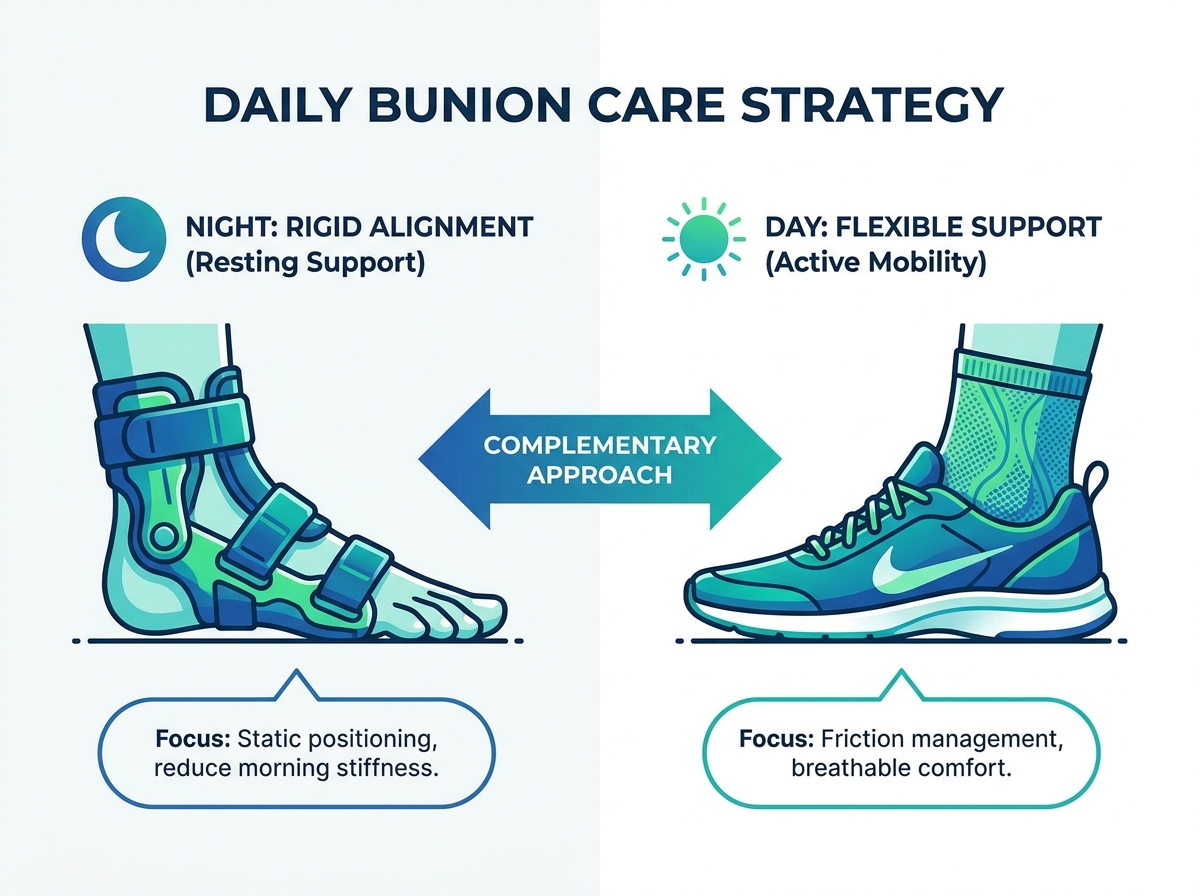
Night splints provide rigid support during resting hours. You wear them strictly while sleeping or lounging. They enforce straight toe alignment mechanically. We must remain transparent about their actual capabilities. Rigid splints may relieve morning stiffness beautifully. They stretch the tight tendons over several hours. They will not, however, reverse the actual bone deformity.
Daytime wear demands entirely different design features. You need flexibility to walk normally. High-quality breathable toe sleeves become absolutely necessary here. We evaluate these daytime sleeves across several specific dimensions. Moisture-wicking materials prevent sweat buildup and dangerous skin breakdown. A low-profile design ensures the sleeve fits inside standard footwear easily. Friction-blocking gel pads protect the protruding joint from shoe rubbing. These features keep you moving comfortably.
Implementation risks exist when using any support wear. Many people make a very common mistake. They squeeze a padded sleeve into tight, restrictive shoes. This approach backfires completely. Restrictive footwear negates the benefits of the support device. It actually increases total pressure on the affected joint. Always pair daytime sleeves with wide-toe shoes.
Table: Wearable Bunion Support Options Comparison
| Device Type | Best Time for Use | Flexibility Level | Key Benefit |
|---|---|---|---|
| Rigid Night Splint | Sleeping / Resting | Very Low | Deep tendon stretching, reduces morning joint stiffness. |
| Breathable Toe Sleeve | Daytime / Walking | High | Blocks shoe friction, manages mild alignment. |
| Silicone Toe Spacer | Daytime / Exercise | Medium | Prevents overlapping toes, relieves inter-digital pressure. |
| Gel Bunion Shield | Daytime / Standing | High | Targeted cushioning directly over the bony prominence. |
A poorly fitted wrap causes more harm than good. Finding the precise fit ensures high compliance and comfort. This section serves as your definitive toe wrap sizing guide. Follow these specific steps for optimal results. Correct sizing prevents dangerous circulation restriction.
Measurement requires careful attention to detail. Grab a flexible soft tape measure first. Measure your feet at the end of the day. Feet naturally swell after hours of standing.
Understanding manufacturer sizing charts prevents costly purchasing mistakes. Small sizes usually accommodate narrower feet. Large or Wide distinctions often depend on your standard shoe size. They also account for overall foot width measurements. Always compare your recorded numbers against the specific brand chart. Sizing varies wildly between different manufacturers.
Fit validation criteria help you adjust the device properly. Pay close attention to how the wrap feels after ten minutes. Too tight a fit causes a throbbing sensation. Your toes might show purple discoloration. You may experience numbness in the extremities. A fit that is too loose causes the wrap to slip during walking. The material bunches up inside your shoe painfully. You feel zero tension pulling on the big toe. Consider material adjustability features carefully. Velcro straps allow quick modifications throughout the day. Daily swelling fluctuates naturally. Adjustable straps accommodate these daily changes perfectly.
At-home care has distinct medical limitations. We must define these boundaries clearly. You need to know when conservative measures fail. Recognizing these warning signs prevents long-term joint damage. It protects your overall mobility.
Specific evaluation dimensions indicate a clear need for escalation. Watch for pain persisting despite consistent conservative management. If four to six weeks pass without improvement, seek help. Inspect the skin directly over your bunion joint daily. Look for skin breakdown, deep ulceration, or severe redness. Any signs of infection demand immediate medical attention. Notice how the pain affects your systemic movement. Severe restriction in daily activities signals a major problem. Altered gait mechanics often cause secondary knee or back pain. Do not ignore these systemic warning signs.
Next-step actions involve professional medical evaluation. Schedule a consultation with a qualified podiatrist. They will assess your foot structure mechanically. You should expect them to order weight-bearing X-rays. X-rays reveal the exact angle of the bone deformity. The doctor will evaluate you for custom orthotics. Prescription orthotics control foot mechanics significantly better than over-the-counter options. Finally, you may discuss surgical shortlisting criteria. A podiatrist will explain exact surgical procedures. They will outline recovery timelines and potential aesthetic outcomes.
Effective daily management demands a dual approach. You must remove daily aggravators like narrow, restrictive footwear. Simultaneously, you must apply appropriate mechanical support. Success relies on consistency and proper implementation. Ignoring the pain guarantees rapid progression of the deformity.
Take immediate action to protect your feet today. Audit your current shoe collection mercilessly. Discard or donate any pairs squeezing your toes together. Measure your feet properly before purchasing any support sleeves. Remain consistent daily to see true structural relief.
A: No. They manage pain, reduce friction, and temporarily align the toe for comfort, but cannot alter the bone structure. Surgery remains the only method for permanent structural correction.
A: Start with 1-2 hours to assess circulation. Gradually increase to full daytime wear if using a flexible, breathable sleeve. Always remove the wrap if you experience numbness or severe throbbing.
A: They share conservative treatments like wide-toe shoes and spacers. However, they require specific padding placements depending on exactly where friction occurs. Hammer toes often need localized digital splinting.
A: Yes, low-impact activities are highly encouraged. Ensure you wear properly fitted athletic shoes. Potentially pair them with a flexible toe sleeve for friction management to maintain joint mobility.


