
English 
T: +86-18251114333
E: kingleo_sz@126.com
E: kingleo_sz@126.com
3rd Floor, Building 2, No. 338 Jiangzhuang Road, Guoxiang Street, Wuzhong District, Suzhou City
Views: 0 Author: Site Editor Publish Time: 2026-06-24 Origin: Site


Consumers and clinicians often confuse toe alignment devices. You might think they all do the same thing to relieve foot pain. However, their mechanical functions and ideal use cases differ significantly. We must clarify an important clinical truth right away. Neither device is a miracle cure for severe foot deformities. Instead, they operate as highly effective conservative management tools. You use them for specific structural issues, targeted pain relief, and post-injury support.
This guide serves as your definitive decision-making resource. We will help you choose the exact right intervention based on your pathology. You will understand how footwear compatibility affects your choice. Ultimately, we aim to match the perfect tool to your lifestyle, ensuring you avoid further discomfort and accelerate your recovery.
Function: A Toe Wrap provides targeted compression and stabilization (often for 1-2 digits), while Toe Separators encourage global anatomical splay across the forefoot.
Primary Use Cases: Wraps are superior for acute injuries (broken toes) and hammer toes; separators are better for bunions, plantar fasciitis, and barefoot shoe transitions.
Wearability: Wraps generally fit inside standard footwear easily; true toe separators require wide-toe-box shoes or barefoot use.
Sourcing: Evaluating material grade (breathable fabric vs. medical-grade silicone) is critical whether buying a single pair or sourcing wholesale Toe Wraps.
To understand these tools, we must look at their core mechanics. We need to define their structural differences clearly. By ignoring marketing fluff, we can see how they perform very different jobs on your foot.
A Toe Wrap functions similarly to clinical "buddy taping." Podiatrists have used buddy taping for decades to treat minor fractures. This device simply modernizes that concept. It uses localized tension to bind an injured or deviated toe directly to a healthy adjacent toe. The healthy digit acts as a rigid, organic splint. This creates a highly stable environment for the injured area to heal.
When looking at material expectations, you will find specific fabrics. Manufacturers typically utilize low-profile, hook-and-loop fabric. Some premium versions feature an ultra-thin foam inner layer. These materials ensure the device remains extremely slim. They prevent unwanted extra bulk between your digits, which could cause secondary pain.
The mechanical goal is highly specific. It focuses entirely on immobilization and friction reduction. A wrap primarily addresses alignment in the sagittal plane. This means it controls up and down movement. It prevents toes from crossing over each other. It also stops them from curling forcefully under downward pressure.
Now let us examine anatomical splaying devices. They work entirely differently from binding fabrics. A separator sits passively in the interdigital spaces. It gently pushes your toes apart. It guides them back into their natural, un-cramped anatomical position. It does not bind toes together for stability. Instead, it creates strategic space between them.
Material expectations shift dramatically here. Manufacturers usually cast these tools from medical-grade silicone or TPE (Thermoplastic Elastomer). These synthetic materials offer incredible flexibility and durability. They can stretch significantly without permanently losing their original molded shape. They also adapt smoothly to your body heat.
The mechanical goal focuses on the transverse plane. This involves lateral, side-to-side expansion. By actively spreading the metatarsals, you improve intrinsic muscle engagement. Your foot can then distribute dynamic loads more evenly across the entire forefoot. This passive spreading mimics how our feet operate naturally when we walk barefoot.
Choosing the right intervention requires matching your specific pathology to the device's mechanics. We have built a clear features-to-outcomes matrix below. It will help you make an informed, clinical-level decision.
You should opt for targeted stabilization when dealing with acute, localized issues. Let us explore the most common scenarios.
Hammer and Claw Toes: A wrap gently pulls a contracted toe down into a neutral position. It prevents the raised knuckle from aggressively rubbing against the top interior of your shoe.
Fractures and Sprains: You need proper splinting during the critical 4–6 week recovery phase. Binding the broken toe to its neighbor prevents micro-movements that delay bone healing.
Corns and Localized Blisters: The soft fabric provides an immediate physical barrier. It protects sensitive skin against pinpoint friction caused by overlapping digits.
You should turn to anatomical splaying when addressing whole-foot alignment and biomechanical fatigue. Toe Separators excel at treating global structural issues.
Bunion (Hallux Valgus) Management: Spacers passively stretch the tight adductor hallucis muscle. We must state explicitly that they only relieve symptoms. They will slow progression. They do not structurally "cure" severe bunions without surgical intervention.
Neuromas and Plantar Fasciitis: They effectively widen the metatarsal heads. This widening decompresses pinched plantar nerves. It also stabilizes the arch by giving your foot a broader, stronger base.
Athletic Recovery and Barefoot Transition: Athletes use them to reverse the cramping effects of narrow, tapered athletic shoes. They stimulate blood flow and help transition runners to zero-drop footwear safely.
Foot Pathology | Recommended Device | Primary Mechanical Outcome |
|---|---|---|
Broken Digit (Fracture) | Wrap | Immobilization and sagittal stabilization |
Hammer Toe rubbing on shoe | Wrap | Downward traction and friction barrier |
Early-stage Bunion | Separator | Stretching of the adductor hallucis muscle |
Morton's Neuroma | Separator | Metatarsal decompression and nerve relief |
Understanding mechanics is only half the battle. We must discuss the actual friction points of daily adoption. Your lifestyle and footwear choices dictate which device will actually work for you.
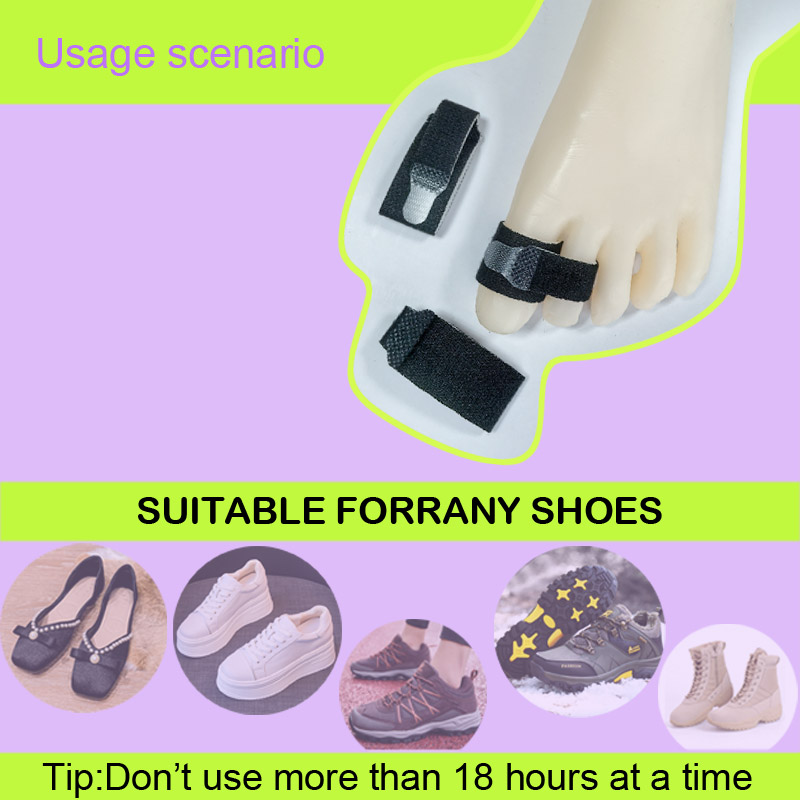
Compatibility determines compliance. Wraps offer incredibly high compatibility. Their low-profile nature means they fit inside almost anything. You can wear them in standard dress shoes, tight soccer cleats, and narrow running shoes. They do not alter the overall fit of your shoe.
Conversely, separators present low to moderate compatibility. They strictly require a naturally shaped, wide-toe-box shoe. If you force them into narrow, tapered shoes, you will cause compression injuries. The added bulk will crush your digits together painfully.
Here is our fundamental decision logic. If you must wear conventional, narrow shoes all day for work, a wrap is often the only viable active-wear choice.
You must ease into wearing these devices. We frequently see users experience intrinsic foot muscle fatigue. Severe cramping occurs if you wear splaying devices for eight hours on your very first day. Your muscles are simply not used to that stretched position.
Follow this safe, progressive ramping schedule for optimal adaptation:
Days 1 to 3: Start with just 30 minutes of passive wear. Sit on the couch or read a book. Do not walk around extensively.
Days 4 to 7: Increase the duration to one hour. Begin light weight-bearing activities around your house.
Week 2: Introduce them into wide-toe-box shoes for short walks. Monitor your arches for unexpected fatigue.
Week 3 and Beyond: Gradually extend to full daily wear as your foot intrinsic muscles adapt and strengthen.
Unlike splaying tools, wraps can typically be worn immediately for much longer durations. Their supportive nature prevents muscle fatigue, making them ideal for immediate, all-day relief.
Quality varies wildly in the foot care market. Whether you need a single pair for yourself or plan to stock a clinic, you must evaluate specific quality criteria. Inferior products will hinder recovery and cause secondary skin issues.
We strongly warn against cheap, degrading plastics. Low-quality materials trap heat and moisture. This easily causes severe skin maceration between your toes. Fungal infections thrive in these damp, compromised environments. Furthermore, cheap plastics lose their elasticity after just a few weeks of use.
We always recommend medical-grade silicone for splaying tools. It resists bacterial growth and washes easily. For binding tools, look for highly durable, washable micro-fleece or nylon. These fabrics breathe well. They prevent sweat accumulation during intense daily activities.
Evaluating vendors requires strict scrutiny. This is especially true when buying individually or seeking whosale Toe Wraps for clinical distribution. You must partner with a legitimate manufacturer.
When assessing any premium foot care products supplier, look for three critical indicators. First, check for hypoallergenic material certifications. Your skin needs protection from contact dermatitis. Second, test for consistent elasticity over time. High reusability determines the true value of the product. Third, demand clear anatomical sizing variations. A strict "one-size-fits-all" approach is a massive red flag in foot mechanics. Human feet vary too much for a single mold to work safely.
We have covered the mechanical differences, the pathologies, and the quality standards. You now possess the knowledge to choose the correct intervention. We can summarize this logic into a simple binary framework for immediate action.
Choose the Toe Wrap if: You have a specific, localized issue. This includes a single hammer toe, a recently broken digit, or a painful friction corn. You need immediate immobilization. You also require a device that fits seamlessly inside standard, narrow footwear without causing bulk.
Choose Toe Separators if: You are addressing global, whole-foot alignment issues. You want to manage bunion pain or reduce general foot fatigue. You are actively seeking athletic recovery. Most importantly, you already have access to wide-toe-box shoes or plan to use them while barefoot at home.
Stop guessing which tool will fix your foot pain. Evaluate your symptoms against this guide. Then, direct your attention to browsing catalogs of professional-grade foot care solutions. Choose the tool designed for your exact pathology.
A: We generally do not recommend wearing both simultaneously. Combining them creates excessive bulk between the digits. They also have conflicting mechanical goals. One binds toes together, while the other forces them apart. You should identify your most pressing pathology and address one primary issue at a time.
A: Wraps are often perfectly safe for overnight splinting, especially for fractures. Separators can technically be worn at night. However, they frequently fall off under the sheets. For beginners, wearing them overnight often causes severe nocturnal cramping in the foot arch.
A: Replacement timelines are dictated by elasticity and basic hygiene standards. The hook-and-loop fabric naturally degrades with repeated tension. Assuming you wash and wear it daily, you should typically replace the unit every 1 to 3 months to maintain proper therapeutic stabilization.
A: We must reiterate the medical reality. These devices provide excellent pain relief. They slow structural progression and effectively stretch tight soft tissues. However, they cannot dissolve existing bone adaptations. Reversing a severe, calcified bunion deformity strictly requires surgical intervention.


